
SitterTree Resources: Insights on Babysitting and Childcare

-
Featured postOur step-by-step guide offers babysitting interview tips to showcase your skills, answer common questions, and leave parents feeling excited to hire you. 1. Do your pre-interview prep Acing your babysitting interview starts long before the conversation even begins. With a little pre-interview preparation, you’ll present yourself as an organized sitter with the expertise the family […]
- View all
- Sitter Tips
- Family Tips
- Tips for Toddlers
-
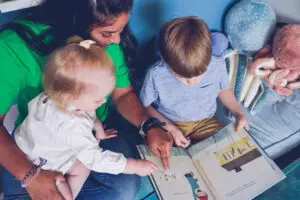
Years before children actually learn to read, they begin to realize that letters and written text carry meaning.
Tell Me More
Research has shown that most toddlers and preschool children don’t pay attention to printed text unless they are encouraged to do so by the person reading the book. Simply by pointing to the text (“print referencing”) while we read a book, we can reverse that trend and get children interested in just what those black lines and squiggles on the page actually mean.
What does point to print achieve in young, pre-literate children? An early understanding that print carries meaning, which supports the growing recognition of letters and is linked to an earlier ability to both name and write letters.
So What?
Event though pointing or even mentioning text clearly provides advantages for literacy development, most carers of toddlers and pre-schoolers don’t refer to a book’s print during a reading session.
Evidence shows that either pointing to or even verbally referring to text significantly increases the amount of time children pay attention to text during storybook reading. By remembering to point to and refer to print, parents can foster children’s mastery of key early literacy concepts.
A note about the author:
Dr. Randa Grob-Zakhary, MD Ph.D. is the Founder of The Babyboost Institute for Early Learning and Development. Want more tips? Purchase Babyboost: 50 Critical Facts on Amazon.
September 6, 2019 -
Like many other skills, creative thinking can be strengthened by early environments.
Tell Me More
Seeing things from different angles is considered a form of abstract thinking, but it has concrete roots in visual-spatial perception. For example, being able to see an object in two different ways of finding objects hidden in drawings.
These skills appear to be responsive to simple activities provided during early development. How could this be important? Children with impaired visual-spatial perception often have difficulties with writing, which can cause them to be incorrectly labeled as diyslexic. Such children can have problems recognizing letters and numbers – the reversal of letters and numbers is very common. Performance on visual analysis and visual/motor integration tasks (eye-hand coordination, for example, copying words from a board, tracing objects, or drawing) is significantly related to academic performance in 7/9 year olds.
So What?
Because the most common cause of no-verbal learning disability in young children is an undiagnosed weakness in visual processing skills, it makes good sense to support visual-spatial perception, visual/motor integration, and abstract thinking with fun yet challenging activities. For example, optical illusions can be easily introduced in illusion-based stories for young kids and can improve visual-spatial abilities, especially when used regularly. Optical illusions can also act as tests to identify children at risk of a non-verbal learning disability. Being aware of these possibilities means that delays or extra developmental needs can be spotted earlier and be better supported during the early years.
A note about the author:
Dr. Randa Grob-Zakhary, MD Ph.D. is the Founder of The Babyboost Institute for Early Learning and Development. Want more tips? Purchase Babyboost: 50 Critical Facts on Amazon.
August 30, 2019 -
As parents, our greatest vision is to have children who have a positive sense of self with enough self-confidence to navigate the challenges of life. Life experience has taught us that at times, we are faced with situations which create fear preventing us from moving forward. One of the greatest gifts you can give to your children are the skills and tools to deal with their own fears to do more in their own lives. This creates a foundation they will draw from daily as they create a life they love.
#1 Fears are normal
The first step in this process is to explain to your children fears are normal. By acknowledging we all have fears within our own mind-body system and expressing this to our children we take away the “scary” thoughts which prevent us from addressing what we are afraid of. We become aware we have nothing to be ashamed of when we realize everyone has fears, be it our parents, colleagues, peers or anybody around us.
#2 See the fear
If we want to be able to release or overcome our fears we need to know exactly what the fear is we are dealing with at any age. It is important to have the words and vocabulary to describe these. Some common fears are fear of not being good enough and failure and not being accepted. There are many! Guide children through a process of asking themselves “what am I
afraid of ?”It is important to know which fears are limiting them in their lives. If they do not know the fear, it remains hidden and cannot be dealt with appropriately. Assist them to write or draw a list of fears they feel are making them feel stuck, anxious or overwhelmed and keeping them from
being happy and peaceful. This is a start to release and let go of what they fear most.#3 The best reason to overcome fear
Overcoming fear is often a challenging process. It can take time and requires us to draw on our inner strength. For this, we need motivation, inspiration, and grit. Help children to connect with a sense of inner purpose, passion, and dreams in their life to give them the desire to overcome whatever obstacles may lie in their path, including fear.
The greatest inspiration we can have is our own dreams, passions, and goals in life. Dreams are beautiful and intimate and will change as we learn and grow as individuals. It is important to always have a dream at any age. Encourage children to go within themselves and dream. Get children to close their eyes and use their imagination to see their dreams, write or draw them down and come up with an action plan to make them real.#4 Action to overcome fear
Once we know what our children’s fears are and we have connected them with the inspiration or a reason to overcome them, they have a base from which to work. Times will arise along their life journey which will require them to push through the boundary of the fear, freeing them from the hold it has over them. I personally know this opportunity is nearby when I feel “butterflies” or energy moving within me. This happens at different times when I need to face fear.
After we take action to face the fear the feeling dissipates, and we build an extra sense of confidence moving forward. Help children to understand this and to know all we can do is our best in life. Teach them to let go of trying to control the outcome of situations or meet everyone’s expectations outside of themselves.
#5 Power of the mind
Visualization techniques have been proven to work on many levels in the brain and body. Using these techniques are extremely beneficial for children and adults in letting go of fear and anxiety. Fear rests in the mind and body; therefore, we can teach children and ourselves to use the mind as a tool to become free. Go within and see where and how the fear rests in the body, and use the power of the mind to release the fear and all the things associated with it.

In my book “ Freeing Freddie the Dream Weaver Workbook and Activity Book” I have incorporated specific visualizations which are easy to access and use from our website. Children are more perceptive than we realize and they often model themselves more on how they see adults behaving than what adults tell them to do. Live by the ways you want your children to be in the world. Teach children to have self-love and compassion for themselves and others. When we are filled with love and compassion there is no room for fear. Be kind and loving to them and others and they will learn the same behavior.
A note about the author:
Brent Feinberg is an integrative healer and author, born in Johannesburg South Africa. Through many years of experience and studying, he has developed a great understanding of consciousness-based health care and wellbeing. Brent is a best-selling author and speaker. “Freeing Freddie – The Dream Weaver” is Brent’s first set of books which have now sold thousands of copies.
August 13, 2019 -
Learning an additional language, especially in early childhood, improves certain brain functions besides language, including overall learning abilities.
Tell Me More
The old myths that bilingual children are somehow more intelligent than other monolingual counterparts, or that early bilingualism causes speech delays, are simply unproven.
Speaking two or more languages doesn’t increase general intelligence measures, but clearly does enhance executive functions. Executive functions, or EFs – the ability to focus on the information needed to complete a task – allow us to keep a goal in mind, take action to achieve that goal, and to shut out other information that might distract us from completing a task.
Therefore, it should come as no surprise that learning additional languages strengthens our EFs by forcing us to activate different languages within fractions of a second or to switch quickly between languages.
So What?
The benefits of bilingualism are already evident by the time your child reaches toddlerhood or preschool age – children with two native languages significantly outperform children who speak one language on cognitive tests that measure reaction time and the ability to exclude conflicting information. Furthermore, speech from multilingual toddlers has been found to be more relevant (meaning the ability to stay on topic) and less repetitive than that of their monolingual counterparts.
Science shows us that while learning additional languages seems to confer benefits at any age, timing does matter. Learning additional languages early in life provides greater benefits than learning as an adolescent or adult, and delays age-related cognitive decline. Whether or not your child is in an environment where an additional language is necessary if possible consider placing your child in a multilingual environment. Not only will their language development be enhanced, but they will also be strengthening their overall learning skills – an indisputable benefit that will last a lifetime.
A note about the author:
Dr. Randa Grob-Zakhary, MD Ph.D. is the Founder of The Babyboost Institute for Early Learning and Development. Want more tips? Purchase Babyboost: 50 Critical Facts on Amazon.
August 2, 2019 -
Being the only female in a family consisting of a husband and five sons taught me a little about males and rearing boys. What I’ve learned over the years can be summarized into one sentence: Boys want to act like grown men, and grown men sometimes want to act like boys. So what’s a mom to do? Try to recognize the “why” behind the behavior, relax, and enjoy them. Though that’s the bare basics, there are some other helpful tips I have come to know and I’d love to share with you.
Lesson #1: Boys are fun
They’re generally competitive, energetic, loud, and they love potty jokes. And they love their mamas. Little boys want their father’s approval, but they want their mama’s admiration.
Lesson #2: Boys Crave Respect
They can’t help it; it’s part of their spiritual DNA. I believe the need for respect is one reason boys are so competitive (at least ours were—still are, in fact). From the book, Wild Things: The Art of Nurturing Boys, by Stephen James and David Thomas, comes the following statement:
The best way for a mother to nurture the heart of her son
Is to develop a relationship with him from an early age that
Is grounded in mutual respect. This means she must show him
She respects his individuality, his feelings, his strengths, and
His needs—especially when she doesn’t agree with him.
Lesson #3: Boys Enjoy Competing
When our sons were growing up together, I could get their cooperation with almost anything if there was a competition involved: unloading groceries, for example.
Back in those days, there was no ordering online or Instacart delivery. It was a weekly trip to the grocery store and three buggies filled with five gallons of milk, innumerable boxes of cereal, loaves of bread, and everything else to feed a small multitude. Unloading all that stuff at home was when the challenge began.
All I had to do was to tell them not to pick up something that was too heavy for them. That’s when they contested to see who could bring in the biggest load. They’d risk a hernia to outdo one another, and then show me their bulging muscles to prove the effort was worth it. Humm…does this sound a little bit like work? Absolutely! And these competitive challenges applied to everything they did.
Lesson #4: Boys Thrive on Tasks Accomplished
One of the healthiest things we did for our sons was to give them a chance to work for a goal. Sometimes they were rewarded with cash, but often the satisfaction of doing a job and being praised was sufficient to keep them motivated.
Lesson #5: Boys Like to Manage One Another
Sometimes this works; sometimes not so much! For example, we had a rule that if somebody burped at the table (which they totally enjoyed doing), that person had to do the dishes. Anything worse than that required cleaning the bathroom. Believe me, everybody was on alert to catch an offender!
Lesson #6: Boys Love Adventure
They love to explore. Because their dad farmed for a living, we were able to rear our tribe in the country, fifteen miles from town. They spent their formative years exploring the woods, the creek, and the fields with their dad and grandfather. When they got a little older, they would pack a snack on Saturday mornings and disappear for several hours. With that freedom came a level of expectation from them. They knew I trusted them to make good decisions and they didn’t want to disappoint me.
Lesson #7: Boys Live Up to Expectations We Put on Them
Our trust in our boys was built with many hours of one-on-one time with each son. For our family, the prime time was at bedtime. Granted, this is when we mothers are most exhausted, but I spent innumerable hours lying beside our boys, “crawling” on their backs, allowing them to share their deepest thoughts and concerns and it opened up an opportunity to bond with them. Establishing this level of trust and expectations paid off in great dividends when they became teenagers. They never let us down because they knew we counted on them.
Lesson #8: Boys Need to Know They Can Trust Us, As Well
Never break their confidence. Nothing shuts down communication quicker and better than for him to find out we’ve repeated or disclosed something he told us in secret.
Lesson #9: Boys Have Tender Hearts
In spite of all the bravado and boisterous behavior, I believe there is a tender heart inside every little boy. I think every little boy responds positively to one-on-one time with each parent. The relationship between a boy and his dad is special and critical to his development, but the thread that ties a son to his mother’s heart is a beautiful thing. As boys mature, they still need to feel they have a soft emotional place to return to, but they appreciate the release and the freedom to be the men God created them to be.
A note about the author:
Careen Strange is the
author of Hello, Young Mothers, an honest and comical look at the realities of day-to-day motherhood. She and her husband, Burt, have been married 50 years, raised five sons, and are now grandparents to 11 grandchildren. To learn more about Careen and her work with young mothers, visit careenstrange.com.July 30, 2019 -
Carefully collected observations indicate that judicious computer use may offer gains for children over three years of age.
Tell Me More
Many researchers recommend against exposing children under three years old to computers. Computers simply do not match children’s learning style at this age, where learning occurs predominantly through the eyes, ears, mouths, hands, and legs. Computers simply don’t meet the developmental requirements and needs of most children under three.
However, research has shown that three and four year olds who use computers in conjunction with adults and with supporting activities that reinforce the major objectives of the chosen activity have significantly greater developmental gains when compared to children without computer experiences in similar classrooms – including gains in intelligence, non-verbal skills, structural knowledge, long-term memory, manual dexterity, verbal skills, problem solving, abstraction, and conceptualization.
In spite of the many benefits, experts also point out drawbacks to preschool computer use. Some express concern for the children’s physical health. Others cite psychological and developmental concerns. Computers and computer chairs and desks are rarely adjusted to child height, which can be problematic for the still-developing muscles and bones of preschoolers.
So What?
Personal computers (PCs) are now owned by 75% of adults in the United States and by around nearly 400 million people worldwide. Young children today encounter PC-related technologies at an early age. In some situations, screen time steals time from other necessary activities that support important areas of development. On the other hand, banning any PC use prevents the acquisition of computer literacy and other helpful skills. By making careful choices, limiting PC use and supervising PC activities, parents can selectively expose their children to supportive technological choices.
A note about the author:
Dr. Randa Grob-Zakhary, MD Ph.D. is the Founder of The Babyboost Institute for Early Learning and Development. Want more tips? Purchase Babyboost: 50 Critical Facts on Amazon.
July 26, 2019 -
During sleep, our brains, especially those of babies and young children, aren’t actually resting – in fact, quite the opposite: the brain continues to be extremely active, laying down pathways and forging new connections while you slumber.
Tell Me More
It’s no big surprise that adequate rest is an important component of child development. One of the most important benefits of sleep is the role that sleep plays in supporting brain development in infants and young children.
While your body is at rest during sleep, your brain seizes this opportunity to engage in some very important work. During this time, the experiences of the day are reviewed, and those events deemed important for the future are converted into more permanent forms of learning. This happens by forming or modifying thousands or tens of thousands of connections between the nerves.
So What?
Because sleep quality and duration are so important for cognitive development, sleep issues aren’t just a hassle; they are potential causes for developmental concern.
Though children differ in their sleep requirements, experts advise that most babies need 15 hours of sleep per night, toddlers 12-14 hours, and preschoolers 10-12 hours. If your child isn’t getting the right amount of sleep and appears to have trouble staying focused, paying attention, remembering things in an age-appropriate way, or often has a disposition that you find challenging or temperamental, a sleep deficit may be the culprit.
A note about the author:
Dr. Randa Grob-Zakhary, MD Ph.D. is the Founder of The Babyboost Institute for Early Learning and Development. Want more tips? Purchase Babyboost: 50 Critical Facts on Amazon.
July 19, 2019 -
No matter how much time children spend in daycare or preschool, research clearly shows that the home environment exerts the most influence on language development.
Tell Me More
Depending on the home environment, there may be significant differences in the number of words and quality of speech that a child hears. These differences can have a striking impact upon a child’s linguistic development:
- Children of more talkative parents can hear up to 4 million more words during the first four years alone.
- Children hearing fewer words per day tend to receive more negative feedback about normal everyday activities of behavior (for example, ‘Don’t do that’) than children hearing more words per day.
- More talkative parents tend to initiate non-essential conversation, rather than only ‘business talk’ (issuing commands, requests, or facts) far more often than less-talkative parents.
- Preschool speech predicts language, reading, and even math skills up to at least the age of ten years.
Multiple studies confirm these findings – and show that children in families where less speech is exchanged are more likely to show a delay in the onset of speech, reduced vocabulary, and immature sentence structure.
So What?
This may be the most important and least disputed fact in this book. Why? Children with advanced language skills tend to have parents with higher levels of education; however, it has also been shown that language can be a greater equalizer among children of different social and economic levels. This potential for overcoming educational as well as socioeconomic differences has formed the basis for many successful national early intervention programs across the globe.
Because preschool language skills are so critical for later reading and speaking skills, parental dedication to providing a supportive home language environment is an important factor in later overall learning success throughout life. This observation does not mean that a child’s language setting outside the home is unimportant, but rather that external environments typically supplement or complement, but cannot replace, the home situation.
A note about the author:
Dr. Randa Grob-Zakhary, MD Ph.D. is the Founder of The Babyboost Institute for Early Learning and Development. Want more tips? Purchase Babyboost: 50 Critical Facts on Amazon.
July 12, 2019 -
Children’s word comprehension develops far faster than speaking ability – even from the first month’s children are capable of understanding far more than we realize
Tell Me More
It’s no surprise that speaking to babies from their very first days supports and stimulates early language development. Thanks to recent research, we now know just how much parents and caregivers influence language skills, and why.
The area of the brain that controls the ability to comprehend works resides at the back of the brain, while the area responsible for speech lies in a higher and more forward position. Because the brain matures from back to front and bottom to top, comprehension advances far faster and earlier than the ability to speak. However, until recently this gap between speech and comprehension wasn’t well understood. Consequently, language is commonly nurtured as a level far below a child’s actual capacity.
So What?
Though you might realize that young children understand more than they speak, the degree of mismatch between speech and word recognition and comprehension might shock you. Language development can be naturally supported in the everyday activities of parents, caregivers, and children.
Provide richer dialogue, narrate frequently, and ask more questions, even those that can be responded to non-verbally. By assuming a greater degree of comprehension, your child’s language development will benefit.
A note about the author:
Dr. Randa Grob-Zakhary, MD Ph.D. is the Founder of The Babyboost Institute for Early Learning and Development. Want more tips? Purchase Babyboost: 50 Critical Facts on Amazon.
June 28, 2019