

SitterTree Resources: Insights on Babysitting and Childcare
-
 Featured postOur step-by-step guide offers babysitting interview tips to showcase your skills, answer common questions, and leave parents feeling excited to hire you. 1. Do your pre-interview prep Acing your babysitting interview starts long before the conversation even begins. With a little pre-interview preparation, you’ll present yourself as an organized sitter with the expertise the family […]
- View all
- Sitter Tips
- Family Tips
- Tips for Toddlers
-

Strong early verbal skills have been linked to greater conceptual understanding of mathematics.
Tell Me More
By now, the advice to speak to your children as much as possible from even the earliest days has reached most parents. However, much less known is that vocabulary size during the preschool years, influenced heavily by parents, is a critical building block for many functions for years to come.
Multiple, respected lines of evidence show that preschool vocabulary size is linked to language and math skills in school, at least up to the age of eight. Similarly, preschoolers with lower vocabulary banks and/or poor language skills often show imparied comprehension, literacy, and mathematical ability.
So What?
It’s common knowledge that early language environments contribute to childhood language skills, but few people have had the opportunity to learn about the relationship between early language environment and math skills.
Because early reading comprehension is related to working memory development and a conceptual understanding of mathematics, building early reading skills can be important factors in success in mathematics. Taken together with other important facts about early language development (facts #21-30), providing a language playground can build a stronger platform for math skills too.
A note about the author:
Dr. Randa Grob-Zakhary, MD Ph.D. is the Founder of The Babyboost Institute for Early Learning and Development. Want more tips? Purchase Babyboost: 50 Critical Facts on Amazon.
June 21, 2019 -

Reinforcing sleep routines means your child goes to sleep earlier and sleeps longer.
Tell Me More
Many parents swear by bedtime routines, and scientific evidence supports this: children who have both a regular bedtime and a bedtime routine fall asleep faster and sleep, on average, longer than children who do not. This fact holds true throughout early childhood, and perhaps most surprisingly, even infants appear to share in the widely observed benefits of bedtime routines.
Of course, this doesn’t work for all families, especially extremely social ones who prefer being out and about with children at night. There’s no one ‘right way – as long as children get adequate sleep and parents recognize the trade-offs they might be making.
So What?
Interestingly, later bedtimes for young babies and children most often do not lead to later morning waking. Many parents put their child to bed later when the child seems to consistently have trouble settling down. Parents often conclude that they simply have tried to put the child to bed too early and believe that the child will fall asleep more easily and sleep longer if they sleep later (for example, 9 pm instead of 7 pm).
However, studies show that in the majority of situations the exact opposite is true: babies often have trouble settling at night because they are over-tired, not under-tired, and will fall asleep longer and sleep later if they go to bed earlier. Adapting to this technique may require some modification of daytime nap schedules – but rest assured it’s well worth it!
A note about the author:
Dr. Randa Grob-Zakhary, MD Ph.D. is the Founder of The Babyboost Institute for Early Learning and Development. Want more tips? Purchase Babyboost: 50 Critical Facts on Amazon.
June 14, 2019 -

You’ve done it! Booked a sitter via SitterTree, snagged that hard-to-get dinner reservation and picked up your favorite dress from the cleaners. Now what? It’s time to get ready for the sitter.
I’m a “planner” by nature and making sure the babysitter is well prepared for her time with my son is important. Hiring sitters through SitterTree takes ALL the guesswork out of things because I know my son will be in very capable and compassionate hands. Yet it’s my job to ensure the sitter can ‘jump right in’ when she arrives and that’s why I use this Babysitter Info Sheet. I fill out an updated version and share it with my sitters via email ahead of their time with us and have a copy printed out at our home when they arrive. In my email, I also include specific directions on how to find our house and where to park; it’s a little tricky. Sharing this information in advance gives me peace of mind because I know the sitter has all of the details she needs.
If your kid(s) are older and can advocate for themselves about what they want and what they need, maybe you don’t need to share a lot of information with the sitter. Or, maybe your baby will already be sound asleep, so you’re wondering what the sitter could possibly need except the remote and WiFi password.
Creating A Helpful Sitter Info Sheet
Not sure what to include in your ‘sheet’? Think about it this way – if YOU were babysitting at another family’s home, what information would be important to you?
Click HERE to create your own Babysitter Info Sheet!
- Sitter Arrival: When the sitter arrives at our home, consider asking your child/children to be there to open the door and welcome her in. This helps to build a bond, even if your child is hesitant about meeting new people.
- Sitter Walk-through: I like to take at least 10 minutes to walk the sitter through the completed sheet and list of instructions and then review where things are kept in our house. If I’m not able to because I’m still curling my hair or putting on makeup, my husband will handle it. This is important because our son has food allergies, so I show new sitters, and remind our favorite sitters, where food is kept that’s safe for him. If a sitter is going to be putting our son to bed, I also show her my son’s bedroom so that she can get the ‘lay of the land.’
Communication Starts with Me
I’ve found SitterTree sitters to be very open and willing to work with you – just ask them to meet the needs you have when it comes to communication.
- How to reach me: I always make sure the sitter has my mobile phone number (and my husband’s) written out for easy reference and that she knows where we’re going to be. For example, if we are going to see a show at The Fox – our phones won’t be on until intermission. Same thing if we’re going to a movie – I don’t want to be ‘that lady’ in the theater.
- Text Updates: Most SitterTree sitters will send you one text message while you’re out. However, I like to communicate when and what information I would like. For instance, I like to get a text message so that I’m aware of when our son has gone to bed and fallen asleep. If we’re out during the day, I like to know what they’ve been up to – riding bikes, going for a walk, things like that. Getting a couple of texts helps put my mind at ease so that I can enjoy my time off.
- Clean Up: While you can expect SitterTree sitters to clean up after all activities and meals, I find it’s easier if I simply communicate what I want my house to look like when I come home – i.e. I am clear that I would like her to clean up the dinner dishes and put the leftovers in the refrigerator. In addition, if I have one or two extra household tasks on my wishlist, I clearly communicate these ideas before leaving.
I hope you’ll use this information sheet the next time you’re lucky enough to have a SitterTree sitter in your home. It’s a great way to keep everyone on the same page and let you have some well-deserved downtime.
Click HERE to create your own Babysitter Info Sheet!
A note about the author:
Rebecca Farrell works full time as a Senior Vice President at a Healthcare Public Relations agency. She’s been married to Christian since 2006, mom to Ronan since 2013 and a Midtown Atlanta resident for the last six years. The Farrell family are avid Disney fans and Rebecca blogs about their experiences on her website, A Mom with Mouse Ears.
June 11, 2019 -

Imaginary friends tend to reflect strong cognitive, social, and emotional skills in young children, rather than being a cause for concern.
Tell Me More
Creating a fantasy friend requires a child to do a lot of mental work – they create something to see and feel out of thin air, right inside their own head. Now that’s an impressive accomplishment.
Imaginary friends don’t indicate, as was previously features, a reluctance to interact with real people, nor are they a sign of social delay. On the contrary, creating imaginary playmates likely results from wanting to interact with peers more than their environment allows. This may be why firstborns tend to have more imaginary friends than their siblings, and children who attend daycare are less likely to do so than their non-daycare counterparts.
So What?
Imaginary friends carry generally positive meanings early in life and are linked to longer-term creativity. Imaginary friends offer opportunities for the teaching and modeling of social skills by creating examples of situations and small dilemmas for a child to resolve. Accepting this phase as part of normal development and being sensitive to your child’s social needs by providing a wider range of social interactions can be useful at this time.
Acknowledging the companion’s existence, setting an extra place at mealtime, providing props to use in imaginary play or even drawing a picture of an imaginary companion together can also send welcome signals of acceptance and encouragement to your child.
A note about the author:
Dr. Randa Grob-Zakhary, MD Ph.D. is the Founder of The Babyboost Institute for Early Learning and Development. Want more tips? Purchase Babyboost: 50 Critical Facts on Amazon.
June 7, 2019 -

Summer is almost here and soon your kids will be out of school! You may be wondering what to do with your kids while they are home for the summer. Here is your summer guide to creative play for your school-aged kids. Not only can you use this information for yourself, but it can be shared babysitters and/or family members who may care for your children.
Outdoor Play
There are countless mental health benefits to unstructured outdoor play time, including practicing healthy social and emotional learning, exercising creative problem solving and employing critical thinking skills. Think about activities you did when you were a child; such as hide-and-seek, playing with water balloons, riding your bike, etc. This type of play fosters independence and promotes healthy socialization for your child.
When children have free play time with others, they need to come up with the rules to their own games. This encourages them to practice critical thinking skills and to work on being emotionally flexible when things don’t go their way. Essentially, they are learning to independently problem solve. These learned skills will help them throughout their lifetime.
Maintaining friendships and making new friends over the summer is also healthy for children. When possible, encourage your children to play with neighbors, peers from school, or friends from summer camp. This will allow them to have fun and maintain social skills learned throughout the school year.
You can even involve your babysitter. Consider setting up playdates for your babysitter and your children with other neighborhood children and their babysitter or parents. Summer experiences are always more fun when they are shared with friends! Here are some fun activities you can try with your children this summer:
- Running through the sprinkler in your yard
- Teaching kids about gardening and planting
- Drawing with sidewalk chalk
- Making tie-dye t-shirts, socks, etc.
- Riding bikes
Indoor Play
It’s good to have a running list of activities, as well, for those days the weather doesn’t cooperate. Before you turn to screens, consider some of the indoor activities listed below:
- Creating your own pillow fort
- Doing arts and crafts
- Making your own pet rock, all you need is a rock and some acrylic or tempera paints!
- Making small sculptures with model magic or modeling clay
- Creating your own puppet using paper bags or socks and then put on a puppet show
- Cooking and baking
- Decorating cookies
- Playing board games or doing good old-fashioned puzzles can be a lot of fun and promote turn-taking, logic and reasoning skills
- Bookmaking and storytelling, kids can create their own books and write and illustrate their own stories
When in doubt, a trip to the local library, swimming pool, or neighbor’s house can be a good way to get out of the house and have fun.
Summer is a great time for children to be creative and continue learning important life skills outside of the classroom. Summer is also a time to help kids continue to grow socially and emotionally while being involved in activities that foster critical thinking and creativity. Giving your children time for unstructured play with others will help them maintain good mental health over the summer and may ultimately ease their transition into a new school year.
A note about the author:
Tristan Ford-Hutchinson, MPS, LAPC, ATR-BC, CCLS is an art therapist and counselor at Peachtree Art Therapy and Counseling who specializes in working with children, young adults and families. Email Tristan Ford-Hutchinson or visit her website to learn more.
May 28, 2019 -
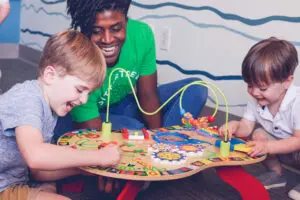
High-quality care before entering school has a significant impact on long-term outcomes.
Tell Me More
While there’s no evidence that anyone specific preschool program is better than another, substantial evidence underscores the fact that high-quality care leads to both short and long-term advantages to your child. The quality of care is not only reflected in the training of staff, planning, and curriculum practices, and in the wider care environment but in the staff’s sensitivity towards the emotional and intellectual needs of children under their care.
Children who attend higher-quality child care centers score higher than those who received lower-quality care on measures of cognitive, language, math abilities and social skills (interactions with peers, problem behaviors) in child care and throughout the transition to school, according to researchers. High-quality child care continues to positively predict children’s performance well into their school careers.
Young children receiving poor-quality childcare are reported to be less prepared for school and tend to have less success in the early phases of school than students who received quality care in their preschool years.
So What?
Though many children will be cared for at home during their early years and others will be exposed to daycare situations, there’s no question that providing appropriate opportunities and guidance for child development leads to long-lasting benefits and helps to ensure school readiness. Failing to do so can be linked to developmental delays and potential long-term problems. Quality care programs can even improve a child’s academic achievement if coming from a family with a disadvantaged socioeconomic status.
A note about the author:
Dr. Randa Grob-Zakhary, MD Ph.D. is the Founder of The Babyboost Institute for Early Learning and Development. Want more tips? Purchase Babyboost: 50 Critical Facts on Amazon.
May 24, 2019 -
Inspired by trusted relationships in a small town, SitterTree is more than an app. Founder, Jody Stephenson, shares her vision for connecting more families with high-quality sitters, and why moms can absolutely trust SitterTree.
SitterTree: Mom-rated Sitters from SitterTree on Vimeo.
May 24, 2019 -

Tiny cells in the brain that act like internal mirrors give us the capacity to copy actions and behaviors as well as feel or empathize with other people’s emotions.
Tell Me More
When I reach for something or feel something, my brain is activated. When I see you reach for something or feel something, my brain also becomes activated. This is because we have cells in our brains, known as mirror neurons, which allow us to copy movements and to feel what others feel.
Copying others is the first form of learning. Connections between mirror neurons and brain centers for movement, sensation, memory, behavior, and emotion support not only traditional modes of learning but also emotional maturation and psychological coping strategies.
Though mirror neurons are present from birth, they become wired to different parts of the brain at specific times throughout early childhood and adolescence. Babies can imitate facial expressions – an early form of empathy. Older children develop more thoughtful components of empathy, invoking problem-solving skills, self-regulation, and self-reflection – all critical underpinnings of solid coping strategies. Recent work shows that some stroke patients and many children with autism often have abnormalities in mirror neuron areas and are therefore not able to fully imitate behaviors and emotions.
So What?
As a parent or caregiver, knowing about the existence and function of our mirroring systems can foster a better understanding of temperament, emotion, and coping strategies during the early years, and may help to explain why changes occur. It also helps to understand, for example, why a young child may simply not be able to understand why they have angered or disappointed you or be fully able to anticipate the emotional consequences of their actions.
Keep in mind your child’s developmental stage – it may be helpful to remember during challenging episodes that young children will most likely prioritize how you say something – meaning your tone of voice or facial expression – over WHAT you say, as they simply don’t yet have the capacity to override this instinct.
When caring for older toddlers and preschoolers, modeling coping strategies, such as verbally breaking down a problem into component parts and tackling each part separately, prompting a child to reflect on how well past treatment of a similar problem worked, or even by staging a recurrent, emotionally challenging situation in an imaginary play setting, can be helpful for many families.
A note about the author:
Dr. Randa Grob-Zakhary, MD Ph.D. is the Founder of The Babyboost Institute for Early Learning and Development. Want more tips? Purchase Babyboost: 50 Critical Facts on Amazon.
May 17, 2019 -

As a new mom, we learn to scrutinize every nuance of our baby to understand what the little person is trying to tell us. Before long we know the difference in the cry for food and the cry from pain. We continuously monitor the signals our infant gives and we’re experts in non-verbal communication. Why? Because it matters. It tells us what we need to know to have a healthy, happy child.
That’s all well and good. However, in the midst of all the attention we give our child, we can neglect the one thing she/he needs most: a healthy, happy mother. In our efforts to be the best we can be–and keep up with the [apparently] super successful mom-bloggers–we can overlook our own physical and emotional needs. As wonderful and miraculous as it is to create babies, it’s easy to channel every dab of our energy toward taking care of them and neglect ourselves, leaving us depleted and weary. You have needs that won’t get met unless you meet them.
So, how do we take care of ourselves?
As a young mom I developed some coping mechanisms, my personal mom hacks if you will: prioritizing, journaling, laughing, and praying,
- Prioritizing: Once I realized I wasn’t just responsible for five little boys, but I was shaping them into the men they would become, my priorities shifted. The children were no longer a part of my life; they were my life. Now that they are adults, I get to be a part of their lives.
- Journaling: When I failed to find the perfect person to be a sounding board for me, I turned to journaling. The collection of writing tablets and spiral bound books became my outlet for the thoughts, emotions, doubts, and victories of everyday childrearing. Once I captured my feelings on paper, I didn’t need to carry them around mentally, so this habit was stress-relieving. If I hadn’t written down experiences as they happened, I couldn’t recall most of them now.
- Laughing: Laughter is good medicine. Find out what tickles you. Some days I embarrass myself by standing in the card aisle laughing out loud. Pausing in the midst of a hectic routine to chuckle at someone’s witticism is refreshing to me. (Nowadays we have to look no further than the emojis and gifs on our phones). Laugh with your children. They will realize soon enough how weighty life can be; encouraging levity helps you both release emotional energy in a healthy way.
- Praying: My biggest survival tool was prayer. My faith is what truly kept me grounded during motherhood. Because of my faith, my life is purpose driven. I know I am chosen to be a mother to our sons. And I know there is a source of strength and wisdom which empowers me to fulfill this role.
How about you, Mom? Are you monitoring your own needs? We want to know your mom-hacks! Share your comments, questions, and secrets (by all means!). We need support, encouragement, and refreshment from each other.
A note about the author:
Careen Strange is
author of Hello, Young Mothers, an honest and comical look at the realities of day-to-day motherhood. She and her husband, Burt, have been married 50 years, raised five sons, and are now grandparents to 11 grandchildren. To learn more about Careen and her work with young mothers, visit careenstrange.com.May 7, 2019